The Supreme Court needs independence. A justice has to be able to tell a president, Congress, or an angry majority that the law doesn’t allow what they want to do. It also needs legitimacy. People should be able to believe that cases are decided on legal judgment, not private favors, undisclosed relationships, or one party’s success at manipulating the appointment calendar.
We have too often treated those goals as opposites. Accountability gets described as an attack on independence, and lifetime tenure gets treated as proof of it. Neither of those is true.
We should keep the current nine justice size of the bench, establish staggered eighteen-year terms with one scheduled appointment every two years, and create enforceable ethics oversight. None of that ends disagreement about constitutional interpretation. It would make the institution less dependent on accident, personal discretion, and tactical advantage.
The Court also sits downstream of the rest of this site. It decides what campaign finance rules we may have, and it shapes the limits of election and districting law. Who appoints its members, and on what schedule, matters to all of it.
Where We Started
Independence was a deliberate choice
Article III says federal judges hold office during good behavior and protects their pay from being cut. The aim is to insulate judgment from political punishment.1 The president nominates and the Senate gives advice and consent. The Constitution doesn’t say nine. Congress set the Court at nine in 1869, after earlier changes.2
So there are two different questions. The number of seats is a matter of statute. The tenure of the people in them raises a constitutional issue.
Independence serves a public purpose: it should protect a justice who makes an unpopular decision. It should not shield conduct that has nothing to do with the merits from ordinary scrutiny.
Lifetime service became an appointment lottery
Under the current arrangement a vacancy depends on death, illness, or the timing of a retirement. Presidents who serve the same number of years can get very different chances to shape the Court. Younger nominees promise longer influence. A justice thinking about retirement knows the party in control may decide the replacement. A vacancy near an election becomes a crisis because its effects can last decades.
Not every retirement is strategic nor every nomination cynical. But the rules invite calculation even from people acting in good faith.
Where We Are
The rules change with the advantage
In March 2016 President Obama nominated Merrick Garland after Justice Scalia’s death. The Republican-controlled Senate Judiciary Committee never considered the nomination. In October 2020, after Justice Ginsburg’s death, a Republican-controlled Senate confirmed President Trump’s nominee, Amy Coney Barrett, shortly before the presidential election.34
| Vacancy | Senate action | Institutional lesson |
|---|---|---|
| 2016: Garland nomination | No Judiciary Committee consideration; no confirmation | A majority can hold a vacancy open for a possible change in presidential control. |
| 2020: Barrett nomination | Confirmed October 26, before the November election | Election proximity did not prevent action when the majority supported the nominating president. |
Republican leaders explained the difference by whether the same party held the presidency and the Senate. That is a political distinction. It is not a neutral, constitutionally prescribed election-year timetable.5
Both parties escalated. Senate Democrats lowered the cloture threshold for lower-court nominees in 2013, and Republicans extended the change to Supreme Court nominees in 2017.3 The decisions, contexts, and consequences weren’t the same, and I won’t pretend they were. But the pattern is plain: procedural restraints weaken when a majority sees an immediate benefit in discarding them.
The Constitution sets no confirmation deadline, so any reform has to deal with obstruction as well as vacancy timing. Regular terms without a workable process would just give us regularly scheduled standoffs.
Ethical concerns deserve more than reassurance
Reports of expensive travel, gifts, outside income, and undisclosed relationships have raised legitimate questions about how the justices manage conflicts. In December 2024 the Senate Judiciary Committee’s Democratic majority staff issued an investigative report criticizing disclosure and recusal practices and calling for enforceable rules.6 That is an investigative and partisan source, not a court judgment on every alleged violation, and it should be read alongside the underlying evidence and the responses. Still, the public shouldn’t have to rely only on a justice’s own assurance.
Justice Clarence Thomas’s travel financed by Harlan Crow is one example. Associated Press reporting in June 2024 described additional trips identified by Senate investigators. Thomas defended his disclosure practice on the basis of advice that hospitality from close friends didn’t need to be reported.7 That is a dispute about disclosure obligations. It doesn’t show that a vote was purchased. It does show why independent evaluation is more credible than leaving the dispute to the person involved. At the very least several of the justices have catastrophically failed to avoid the appearance of impropriety which is a standard to which many other officials are held and which should be the bare minimum for the country’s highest court.
The real ethical question is bigger than bribery. A judge may sincerely believe a friendship has no influence while reasonable observers see a troubling relationship. Appearance matters because litigants can’t inspect a judge’s private reasoning.
A code exists; enforcement is the question
The Court adopted a written Code of Conduct in November 2023, covering impartiality, political activity, outside activities, and recusal.8 The weakness is accountability. The code creates no independent complaint-and-adjudication process, and a rule that depends on each justice’s own assessment is thin comfort when that judgement is the thing in dispute.
Federal law already covers disqualification. Section 455 of Title 28 applies to justices as well as other federal judges, including situations involving impartiality and financial interests.9 The question is how anyone credibly evaluates compliance at the highest court.
There has been useful administrative progress. In February 2026 the Court announced software for automated conflict checks, backed by revised filing rules effective in March.10 Catching conflicts earlier helps. Software doesn’t decide contested ethical questions or provide independent enforcement.
Alternatives and the Principles They Suggest
Protect judgment without making service indefinite
The choice isn’t lifetime tenure versus judges campaigning for reelection. A long, nonrenewable term protects a justice from immediate political pressure and still gives predictable turnover. Eighteen years spans several administrations and congressional majorities. Making it nonrenewable removes any temptation to please whoever could grant another term. An eighteen-year term is a significant part of a career for most people, and should be long enough to spend in one job.
The Brennan Center’s eighteen-year proposal and the term-limit bills in Congress show this is a developed idea, not just an appealing round number.1112
Regular appointments would also reduce the premium on the youngest possible nominee. Experience could count for more when appointing a forty-five-year-old rather than a sixty-year-old no longer promises fifteen more years of control.
Oversight should review conduct, not punish decisions
An ethics system has to separate conflicts, gifts, disclosure failures, and misuse of office from disagreement with a ruling. If elected officials could sanction a justice for an inconvenient decision, independence would be destroyed. But treating every investigation as retaliation would make real standards impossible. A conflict rule is valuable exactly when the person subject to it would prefer not to step aside.
The test is whether the process is neutral, evidence-based, and constrained. Who may complain? Who investigates? What standard applies? Is there a right to respond? Are conclusions explained? Can the process itself be reviewed?
Potential Solutions
Nine seats, one regular appointment every two years
Establishing nine active seats with fixed, staggered eighteen-year terms is a well thought out proposal that should be enacted. In the mature system one term would end every two years, so a president serving a full four-year term would ordinarily make two nominations, subject to confirmation.11
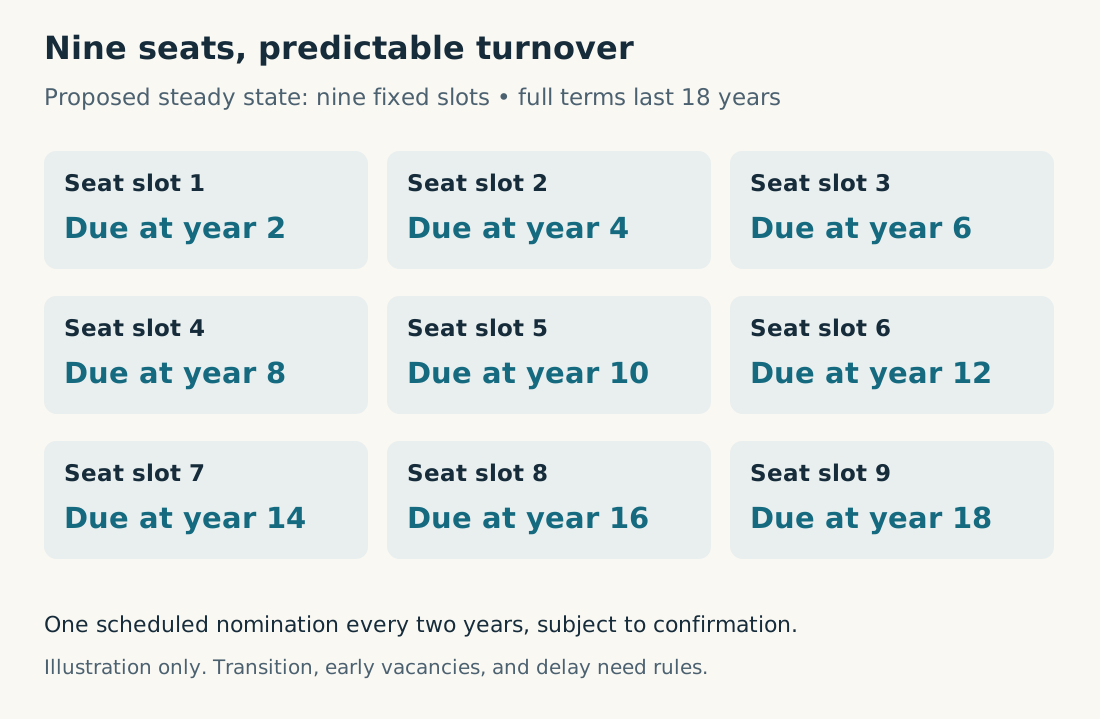
Proposed steady-state schedule, not a transition calendar for the current justices. Vacancies and delayed confirmations need separate rules.
That spreads appointment opportunities more evenly. It would not turn the Court into a mirror of the latest election, and it shouldn’t; constitutional adjudication needs distance from short-term politics. We should also bar renewal or extension of the active term, and avoid post-Court arrangements that let a justice’s next employer create conflicts in the final years. With a functional retirement system that I believe already exists, even significant restrictions on post-term employment should not be constraining after an 18-year term. A judicial appointment should carry a lifetime benefit, it need not be a path to extreme wealth.
Make the difficult details explicit
“Eighteen years” as a slogan leaves a lot unanswered:
- Early vacancies: a replacement should fill the remainder of the seat’s term rather than restart the clock. Otherwise an early departure recreates the lottery.
- Obstruction: nominations need a defined process for hearings and a decision. A deadline is worthless unless the consequence of missing it is specified.
- Delayed confirmation: the seat schedule should continue. Delay shouldn’t produce a longer term or an extra future appointment.
- The Chief Justice: the chief’s administrative role needs its own clear selection and term rules, not an exception that swallows the reform.
- Transition: current service, future appointments, and the start of staggering need a published plan adopted before anyone knows its partisan results.
There is a tradeoff. Filling an early vacancy still gives a president an extra nomination, even if the long-run schedule is unchanged. No honest proposal can promise that unexpected deaths stop mattering. This particular situation is no worse than the current status quo.
For confirmation obstruction we need an amendment specifying an enforceable decision process while keeping a real Senate role. Silence shouldn’t be a permanent veto, and confirmation shouldn’t be automatic because a calendar ran out. The fallback has to be designed, not left to partisan improvisation. This can likely be legislatively adopted early with an intent for constitutional amendment to prevent politically motivated changes to the process.
Use a route that can withstand challenge
Some term-limit proposals keep lifetime judicial office but limit regular Supreme Court service, with senior status afterward. Supporters say Congress can do that by statute. Opponents dispute whether Congress can redefine the office that way.1112
The ideal is a constitutional amendment for fixed terms. It is the harder political route, but it deals directly with Article III and lets the appointment schedule and the anti-obstruction provisions be adopted together. An amendment needs proposal and ratification under Article V.1 Difficulty is not a reason to pretend an ordinary statute is unquestionably enough. It also isn’t a reason to put off ethics work and pure legislative implementation in the meantime.
Build an ethics system the public can inspect
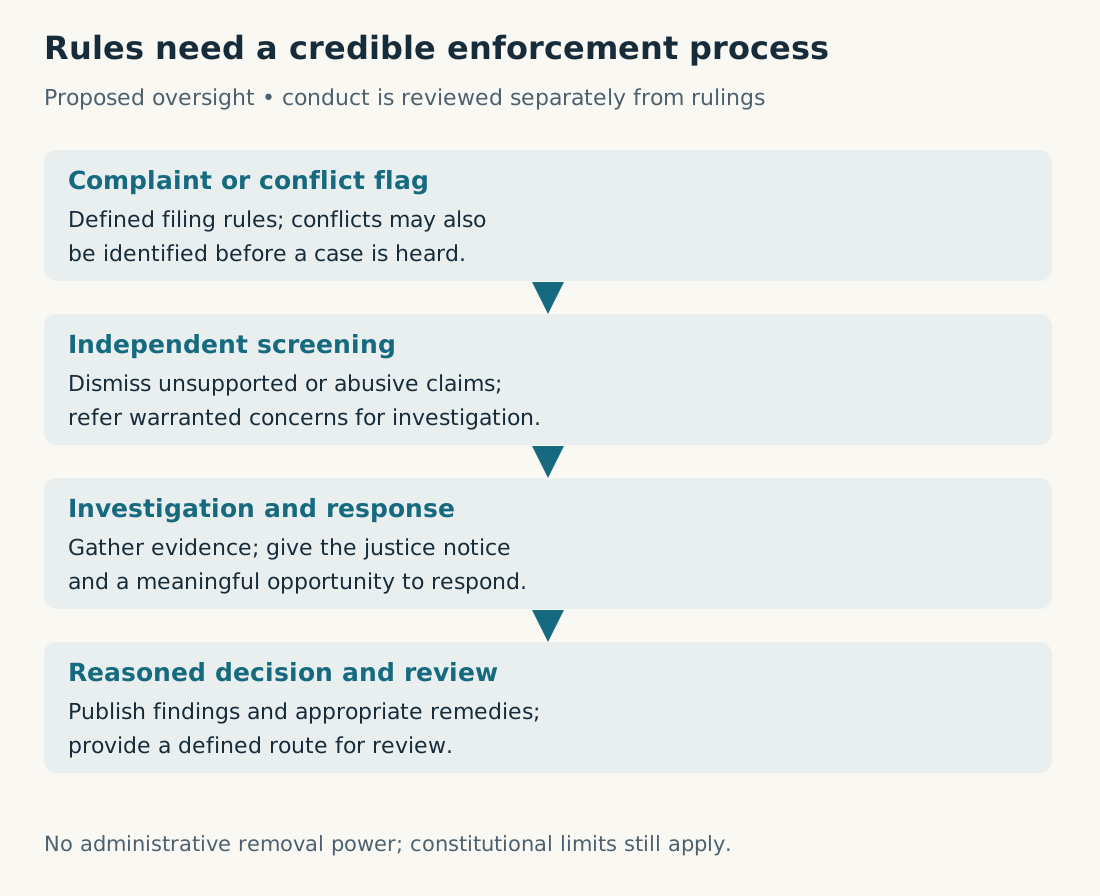
Proposed oversight structure. Its legal authority and remedies would need to be defined consistently with judicial independence and constitutional removal provisions.
I would require timely, searchable disclosures; strict limits on gifts and privately financed travel; clear rules on investments and outside income; and written explanations of significant recusal decisions.
An independent ethics office should be able to receive complaints, screen out unsupported ones, obtain information, and investigate substantiated concerns. A separate, carefully constituted review body should decide contested matters, so the subject of a complaint doesn’t control the outcome. A justice should get notice, access to the evidence, a chance to respond, and a defined route for review, and the system needs protection against repetitive complaints aimed at keeping someone out of a particular case.
Remedies must fit the authority: corrected disclosures, published findings, lawful recusal procedures, and referral for further action. Ethics administrators shouldn’t get an invented power to remove Article III judges. Impeachment stays a constitutional process, not a substitute for everyday oversight.
This connects to money in politics. Concentrated wealth can influence institutions without buying a vote outright, and a public system should guard against privileged access and hidden dependence before anyone has to prove an explicit bargain. A Court that can enforce limits on everyone else should accept limits on itself. Independence and accountability reinforce each other when both are designed to serve the public.
References and Further Reading
National Archives, The Constitution of the United States: A Transcription, Articles II, III, and V. ↩︎ ↩︎
Supreme Court, Frequently Asked Questions: General Information, including appointment, tenure, and the Court’s statutory size. ↩︎
U.S. Senate Historical Office, About Judicial Nominations: Historical Overview, including the Garland nomination and changes to cloture rules. ↩︎ ↩︎
U.S. Senate, Roll Call Vote 224, Confirmation of Amy Coney Barrett, October 26, 2020. ↩︎
Senate Judiciary Committee, October 15, 2020 Barrett Hearing Transcript, transcribed by Rev, including Chairman Graham’s explanation of the same-party distinction. ↩︎
Senator Dick Durbin’s office, Senate Judiciary Committee Releases Investigative Report on Ethical Crisis at the Supreme Court, December 21, 2024. Links to the Democratic majority staff report and appendices; findings and characterizations remain attributable to that investigation. ↩︎
Associated Press, Additional Crow-Financed Travel and Thomas’s Response, June 2024. ↩︎
Supreme Court, Code of Conduct for Justices, November 13, 2023. ↩︎
28 U.S.C. § 455, statutory disqualification requirements, reproduced by Cornell’s Legal Information Institute. ↩︎
Supreme Court, Press Release on Conflict-Checking Software and Revised Rules, February 17, 2026. ↩︎
Alicia Bannon and Michael Milov-Cordoba, Brennan Center for Justice, Supreme Court Term Limits, June 20, 2023. A policy proposal, including an argument for statutory implementation. ↩︎ ↩︎ ↩︎
Representative Hank Johnson’s office, Supreme Court Justice Term Limit Measure, May 21, 2025. Sponsor’s account of proposed legislation; not a declaration that its constitutionality is settled. ↩︎ ↩︎