The United States political system gives the people already in office considerable control over who can replace them. They write the election rules, and in most cases the party in power draws the electoral districts. Money is needed to run political campaigns (see money in politics), most prominently to market the candidate and his or her positions. For many reasons, the incumbent has advantages in raising money and generating free publicity. We then act surprised when the resulting legislature is difficult to dislodge. Senator Chuck Grassley (R-IA) has been in office since 1981. Senator Mitch McConnell (R-KY) has been in office since 1985. Representatives Hal Rogers (R-KY) and Chris Smith (R-NJ) have been in office since 1981. While the oldest, these are not outliers. A quick analysis of 2014 to 2024 found members were about twice as likely to leave on their own terms or die as to be voted out.
Gerrymandering is the most obvious abuse, but the problem goes beyond manipulated maps. Even an honestly drawn set of districts can leave a large number of people with little political representation. We award one seat to one winner, then discard everyone else’s preferences when allocating seats.
I think a better system is to elect the House through ranked choice voting in districts with several representatives, using a proportional counting method. That needs to be combined with independent redistricting. More voters would then be able to elect representatives who share their views, and the party drawing a boundary would have less power to determine the result.
Where We Started
The Constitution was a compromise among former colonies trying to form a workable government. Large states wanted representation based on population. Small states wanted equal standing. The resulting Congress defined by the US Constitution has a House apportioned by population and a Senate with two members from each state.1
That arrangement helped secure agreement in 1787. It is arguably not the best arrangement now, if ever. Some of the bargains were indefensible even then, notably the three-fifths clause which increased slaveholding states’ representation by counting people those states enslaved but denied any political voice.2 The founders negotiated a government they could get adopted. They did not finish the work of designing representative democracy, nor did they believe they had.
The Electoral College incorporated the states’ House seats and their equal Senate representation into presidential selection. Organized parties soon exposed problems with the original procedure, requiring the Twelfth Amendment. Most states now award all their electors to the statewide winner, although the Constitution does not require that winner-take-all practice.34
The Constitution did not require two parties either. Our election rules have helped make two parties the practical limit, giving each a broad coalition of voters who often agree on little except that they dislike the other party more. Too often this dislike of the “other” doesn’t even react to changes in the “other” party’s positions when they change.
Manipulating districts came early. Gerrymandering takes its name from a Massachusetts districting law signed by Elbridge Gerry in 1812.5 Its appeal has not changed: arrange the voters so that your side wins more seats without needing more votes. The modern version has far better tools, but the conflict of interest remains the same.
We have changed the constitutional system repeatedly when its limitations became unacceptable. Its age is an explanation for some of its problems, not a reason to perpetuate them.
Where We Are
The maps are often misleading
A county map colored red or blue makes a sparsely populated area look politically enormous. A city may contain more voters while occupying a small patch of the picture. Giving the entire county its winner’s color also makes the losing voters disappear.
World Mapper maps of recent elections show how much the picture changes when geography is resized by population.6 They are worth comparing before using a mostly red or mostly blue map as evidence of what Americans want.
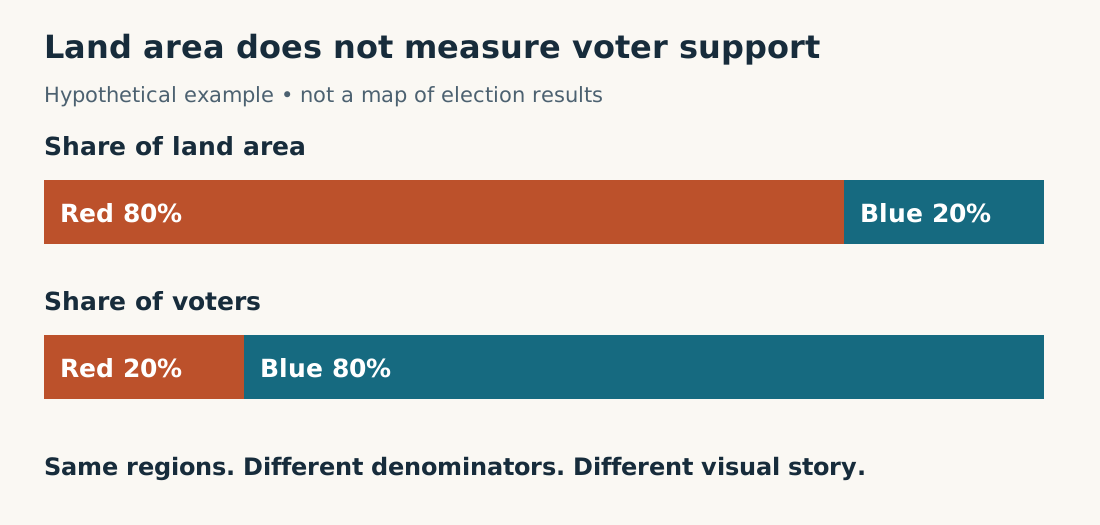
An illustration of the difference between land area and voters, using hypothetical numbers.
A fair-looking map can still produce a poor result
Suppose five equally populated districts each vote sixty percent for Party A and forty percent for Party B. Party A wins all five seats. Party B’s voters are two-fifths of the electorate and elect none of their candidates.
No gerrymander was necessary. Single-member districts produced that result by awarding every seat to a local majority. Research on political geography explains why better boundaries alone cannot reliably produce proportional representation.7
Gerrymandering makes this weakness useful to the people drawing the map. They can pack opposing voters into a few districts won by huge margins and crack the remainder among districts where they cannot win. Equal population does not prevent either technique.
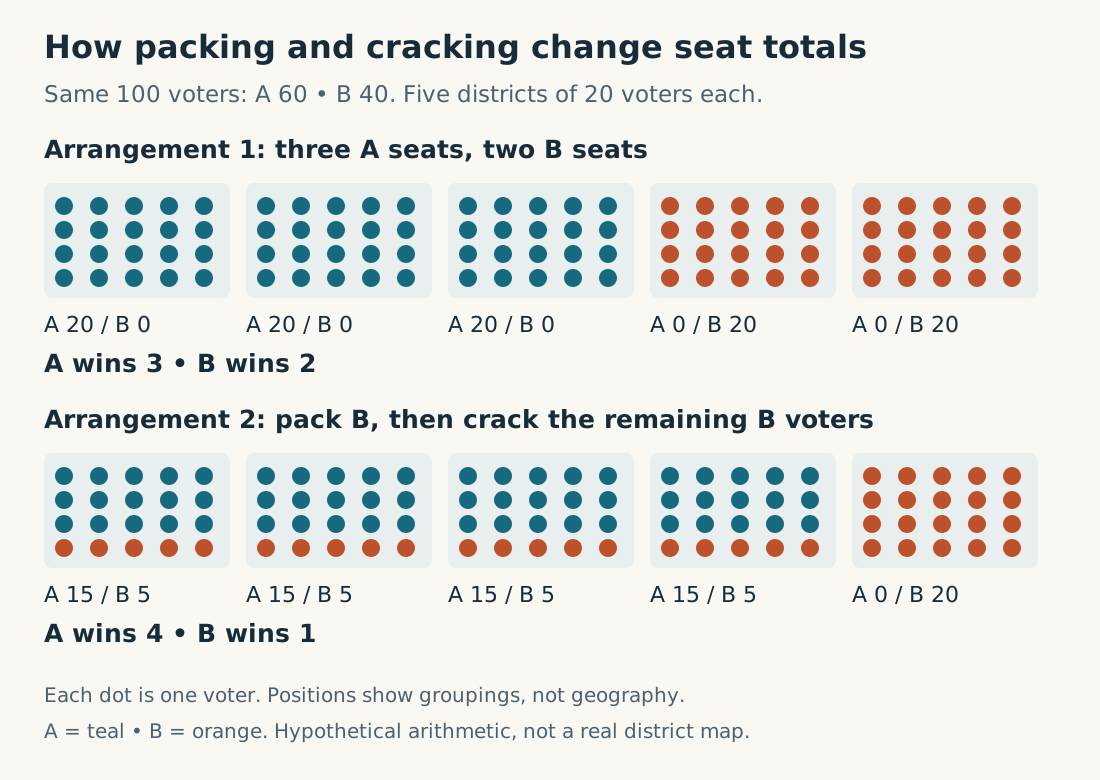
The arithmetic of packing and cracking. These groups are a schematic, not a proposed geographic map.
An independent commission can remove the most direct conflict of interest. It cannot give a single district more than one winner. I support commissions, but stopping there would leave much of the problem in place.
Two parties, often one meaningful contest
Under first-past-the-post, a candidate can win with forty percent when the other sixty percent is divided between opponents. That gives voters a reason to abandon their preferred candidate if that candidate appears unlikely to win. Vote for someone you do not particularly like, or risk helping someone you like even less.
The two major parties benefit from that calculation. A new party has to persuade people to support it and persuade them that supporting it will not be self-defeating. That is a substantial barrier before questions of money and ballot access even arise.
Gerrymandering can narrow the choice further. In a safe district, the dominant party’s primary may effectively choose the representative. The general election then ratifies a decision made by a much smaller group. A member still has a duty to serve every constituent, but many constituents have little practical ability to replace that member with someone closer to their views.
Telling those people to vote harder is an inadequate response. We need rules under which their votes can elect somebody.
Because of its design to emphasize state representation, the Senate’s imbalance has become extreme. California had about 68.5 times Wyoming’s resident population in the 2020 Census. Both states had two senators.8 This is not even the representation difference apparent at the signing of the Constitution.
Minimum and maximum constituents per senator
| Comparison | Founding-era states (1790) | Current states (2025) |
|---|---|---|
| Least-populous state | Delaware | Wyoming |
| State population | 59,094 | 588,753 |
| People per senator | 29,547 | 294,377 |
| Most-populous state | Virginia | California |
| State population | 747,610 | 39,355,309 |
| People per senator | 373,805 | 19,677,655 |
Sources: official 1790 census tables9 and Census Bureau 2025 estimates10.
That means Wyoming’s average population per senator is about ten times Delaware’s in 1790. California’s average population per senator is about 53 times Virginia’s in 1790. The national average rose from about 151,000 people per senator to 3.42 million, roughly 23 times as many.
The key change is not simply that each senator represents more people. It is that the disparity between states has grown dramatically.
- In 1790, the most-populous state’s senator represented about 12.7 times as many people as the least-populous state’s senator.
- In 2025, that ratio was about 66.8 to one.
Defenders say this protects small states from large ones. It does so by giving the residents of those states very different amounts of representation. While small-state residents deserve enforceable rights and a voice in government and large states should not be able to simply impose their will on small states. They do not need vastly greater representation per person to have either. Constitutional rights should protect people from an abusive majority wherever they live; weighting representation by state boundaries is a poor substitute.
Alternatives in other countries and some states
Changing the form of government would not automatically fix this. The United Kingdom has a constitutional monarchy and parliamentary government, but its House of Commons is elected through single-member plurality contests.11 Importing a parliamentary system while retaining that method would preserve the same basic opportunity to turn a modest voting advantage into a much larger seat advantage.
New Zealand’s mixed-member proportional system addresses the allocation of seats more directly. Voters choose a local candidate and a party. List seats compensate for constituency results so that the party vote largely determines each qualifying party’s total representation.12 Winning extra districts through favorable boundaries therefore offers much less leverage over the final balance.
That would be a substantial improvement over our system. I prefer Ireland’s approach for the House: multi-member constituencies using the single transferable vote, or STV. Voters rank individual candidates and can cross party lines or choose among candidates within a party.13 It offers proportional representation while leaving the choice of representatives more directly with voters, without a separate tier of party-list seats.
The tradeoff is that STV does not promise an exact statewide match between party vote shares and seats. District size and transfers affect the outcome. I would accept that in exchange for candidate choice and geographic representation, particularly because it would still greatly improve the opportunity for substantial minorities to elect someone.
More parties could mean more legislative bargaining. Our two parties already contain factions that bargain,14 threaten to withhold support, and disagree about policy. I would rather give voters a clearer choice among those positions than require them to buy an entire party package and hope the internal negotiations go their way.
Alaska is an example of an open primary state15, a policy that should become universal. It substantially cuts down the power of tiny minorities voting in party exclusive primaries.
The solutions, or at least improvements, are known
Ranked choice by itself is insufficient. In a single-seat contest it lets voters identify fallbacks, reducing the pressure to abandon a first choice immediately. The district still has one winner. Its boundaries can still make the decisive difference.
For the House, I would combine ranked ballots, several seats per district, proportional counting, and open primaries. Each voter has one transferable vote. Candidates reaching a quota are elected; surplus votes or voting weight move to subsequent preferences. When necessary, the lowest candidate is eliminated and those votes transfer. Counting continues until the seats are filled.1316
In a five-seat district, the usual quota is just over one-sixth of valid votes. A group need not become a local majority before it can elect a representative. That is the change that matters for both representation and gerrymandering.
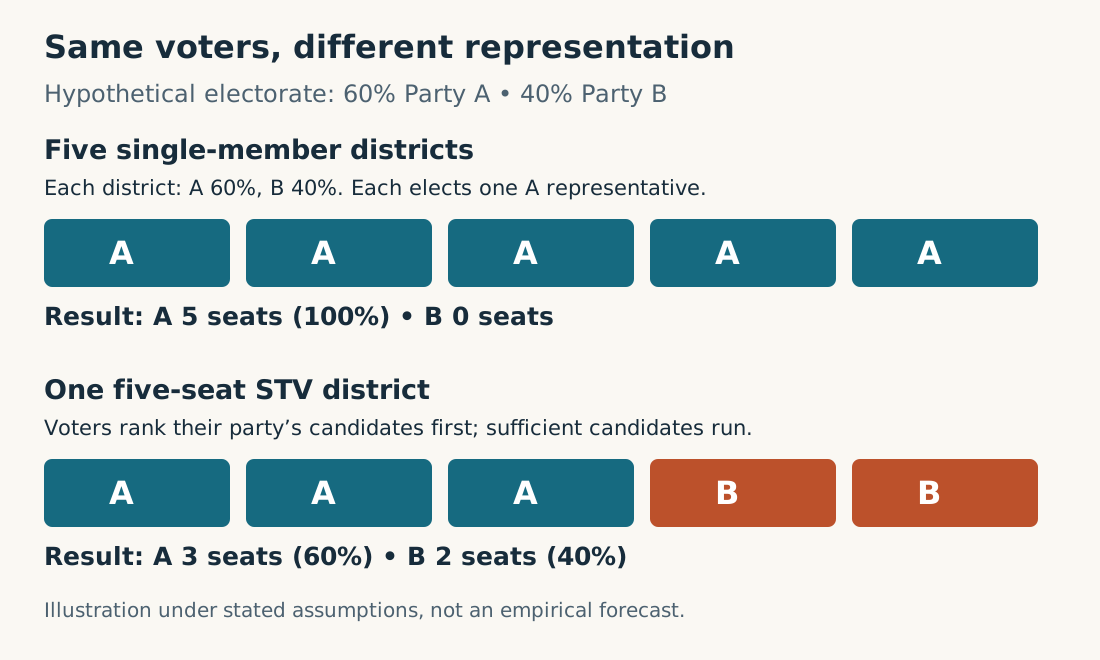
Illustration assumes enough candidates and voters ranking their party’s candidates first. Actual results depend on rankings and transfers.
Simply creating five seats and letting everyone vote for five candidates would not accomplish this. An organized majority could sweep all five. Multi-member districts need the proportional method; otherwise we risk enlarging the district while preserving the exclusion.
Research modeling U.S. House elections finds that multi-member STV districts substantially limit the advantage available through partisan gerrymandering.17 Independent commissions would then be working with an electoral method less vulnerable to boundary manipulation, rather than trying to compensate for its basic design.
I would generally favor districts with three to five members, adjusted to each state’s delegation. Boundaries and district size would still need scrutiny for their effects on racial and language minorities and communities of interest. A reform should make it easier for those voters to elect candidates, not hide dilution inside a larger district.
The objection about losing a single local representative is less persuasive when that representative can safely disregard a large part of the electorate. Several representatives would give a constituent more people to approach and a better chance of finding one sympathetic to the problem. Larger rural districts would need properly funded local offices so that this does not become an excuse to make representatives physically inaccessible.
The count would be more complicated. That calls for clear transfer rules, paper records, published results, and appropriate audits. It is a solvable election-administration problem, with functioning examples abroad. Keeping a simpler count is a poor bargain if it keeps producing a less representative legislature.
We can start without amending the Constitution
The single-member requirement for House elections is statutory: 2 U.S.C. § 2c. Congress can change it under its authority over congressional election rules.1819 The Fair Representation Act introduced in 2024 is an example of legislation combining ranked choice, multi-member districts, and redistricting reform.20
House seats would still be apportioned among states, so districts would remain within state boundaries. A state with one House seat would still elect one representative. We should also increase the House beyond 435 members, another number established by law, to improve constituent access and make multi-member districts possible in more states.21 A 600 member house is large to be sure, but “only” a 40% increase. Using the 2020 census apportionment populations, the Huntington-Hill method, and a minimum of two seats per state, California would get the most seats (71) and Wyoming would have the smallest districts (about 289,000 people). The national average would be about 552,000 per district. That compares with roughly 786,000 per district today, using the Census Bureau’s 2025 population estimate spread over 435 seats. (The current districts were drawn for about 761,000 people after the 2020 census and have grown since.) Forty states land between about 515,000 and 615,000 people per district. The two-seat minimum pushes the smallest states below that range: Wyoming is lowest, then Vermont (323,000), Alaska (368,000) and North Dakota (390,000). Idaho has the largest districts at about 614,000. Eight states sit at the 2-seat floor: AK, DE, MT, ND, RI, SD, VT, and WY.
Replacing the Electoral College with a direct national vote requires constitutional change. Altering equal state representation in the Senate faces Article V’s additional protection of each state’s equal suffrage without its consent.222 Those are harder changes, and both run through a Court whose appointment and ethics rules I would also change. They should not hold the House reform hostage. Open primaries also require no constitutional change and would immediately have an effect on Senate elections.
The immediate proposal is practical: change the federal districting law, establish proportional ranked choice elections, and take mapmaking out of the hands of the legislators who benefit from it. Fund the transition and make the count auditable.
The people benefiting from safe seats and limited competition have little reason to volunteer for this. That explains much of the resistance. It does not make their preferred rules appropriate for the rest of us.
The same insiders-write-the-rules problem shows up elsewhere. Campaign spending is covered in money in politics, the Supreme Court’s appointment and ethics rules in the Supreme Court, and the economic version of it in economic policy. Healthcare is a good test case of why a legislature that answers to voters matters: the healthcare article describes a solution that is well known and still blocked.
References
U.S. Senate Historical Office, A Great Compromise. ↩︎
National Archives, The Constitution of the United States: A Transcription, especially Article I, Sections 2–4, and Article II. ↩︎ ↩︎
National Archives, Electoral College History. ↩︎
National Archives, The Constitution: Amendments 11–27, especially Amendments XII, XIV, XV, XVII, XIX, XXIV, and XXVI. ↩︎
Neely Tucker, Library of Congress, Gerrymandering: The Origin Story, July 18, 2024. ↩︎
World Mapper, Cartograms of the 2024 Election Results, These show a historical election, not present-day party support. ↩︎
Moon Duchin and Gabe Schoenbach, Redistricting for Proportionality, research paper, 2023. ↩︎
U.S. Census Bureau, 2020 Census Apportionment Results Delivered to the President, April 26, 2021. Comparison uses resident population: California 39,538,223; Wyoming 576,851. ↩︎
U.S. Census Bureau. 1790 Census: Population of the United States. Historical census records and state population tables. https://www.census.gov/history/www/through_the_decades/overview/1790.html ↩︎
U.S. Census Bureau. State Population Totals and Components of Change: 2020–2025. State population estimates. https://www.census.gov/data/tables/time-series/demo/popest/2020s-state-total.html ↩︎
UK Parliament, Parliament and Crown; House of Commons Library, Voting Systems in the UK. ↩︎
Elections New Zealand, What Is MMP?. ↩︎
Ireland’s Electoral Commission, Ireland’s Voting System. ↩︎ ↩︎
Unite America Who Really Elected the Freedom Caucus and The Squad? Hardly Anyone ↩︎
Unite America Alaska’s Election System Blunts Political Gamesmanship ↩︎
Australian Electoral Commission, How the Senate Result Is Determined. This documents one specific STV implementation, including quota, surplus transfers, and exhausted ballots. ↩︎
Nikhil Garg, Wes Gurnee, David Rothschild, and David Shmoys, Combatting Gerrymandering with Ranked Choice Voting: An Experimental Analysis of Multi-member Districts in the United States. Research first posted in 2021; the linked record includes revisions. ↩︎
2 U.S.C. § 2c, the statutory single-member district requirement. ↩︎
Library of Congress, Constitution Annotated, Congress and the Elections Clause. ↩︎
U.S. Government Publishing Office, H.R. 7740, Fair Representation Act, introduced March 20, 2024, 118th Congress. Proposed legislation, cited as an example rather than as current law. ↩︎
U.S. House of Representatives, History, Art & Archives, Determining Apportionment. ↩︎
Library of Congress, Constitution Annotated, Unamendable Subjects, discussing Article V’s equal-suffrage provision. ↩︎