Every citizen has one vote. We do not have the same ability to put an issue on the agenda, fund a campaign, or keep an argument in front of the public. Some of that is unavoidable. People have different skills, audiences, and commitments. But persuasion earned through public support is not the same as influence bought with a fortune, and a democracy ought to tell the difference.
We need to reverse the constitutional rule from Citizens United, along with broader campaign-finance reform. Of course, people must have the right to criticize government, organize, publish unpopular arguments, and challenge the people in office. The design problem is protecting those freedoms without treating unlimited money as an untouchable part of political liberty.
This is closely tied to who draws the maps and counts the votes, to how concentrated economic power protects itself, and to who sits on the Supreme Court, which decides what campaign finance rules we are allowed to have.
Where We Started
Money helps make speech possible
Printing a leaflet costs money. So does a website, a meeting hall, or an advertisement. A law controlling political spending can therefore control opportunities to communicate.
That is the serious free-speech argument against careless regulation, and it should not be dismissed just because a wealthy speaker invokes it. A rule that restricts a corporation today can be turned on a union, a neighborhood group, or a dissident publisher tomorrow. But we need to remind ourselves over and over, as our political system has not, that corporations are not people. People have rights endowed by their creator. They have thoughts and feelings and desires. Corporations do not, and we far too often confuse the two.
But campaigns also need money to compete, and the people who can supply it in large amounts get opportunities ordinary constituents don’t. We have to protect expression and resist financial dependence at the same time.
The doctrine did not begin in 2010
In Buckley v. Valeo (1976) the Supreme Court separated contributions from expenditures. It upheld important contribution limits and struck down several limits on spending, including independent expenditures and a candidate’s spending of personal funds.1
A contribution hands resources to a campaign. An independent expenditure buys political advocacy outside the campaign, without coordination. Both can move an election, but the law treats them differently. So reform can’t be reduced to one decision or the slogan that money is speech.
Where We Are
What Citizens United actually changed
In Citizens United v. FEC (2010) the Court struck down restrictions on corporate independent expenditures and electioneering communications. The reasoning covers unions too. It left the disclosure and disclaimer requirements alone and did not touch the ban on corporations giving directly to candidates.2
So no, corporations cannot write unlimited checks to a federal candidate. Nor did the decision invent spending by wealthy individuals; those protections already existed.
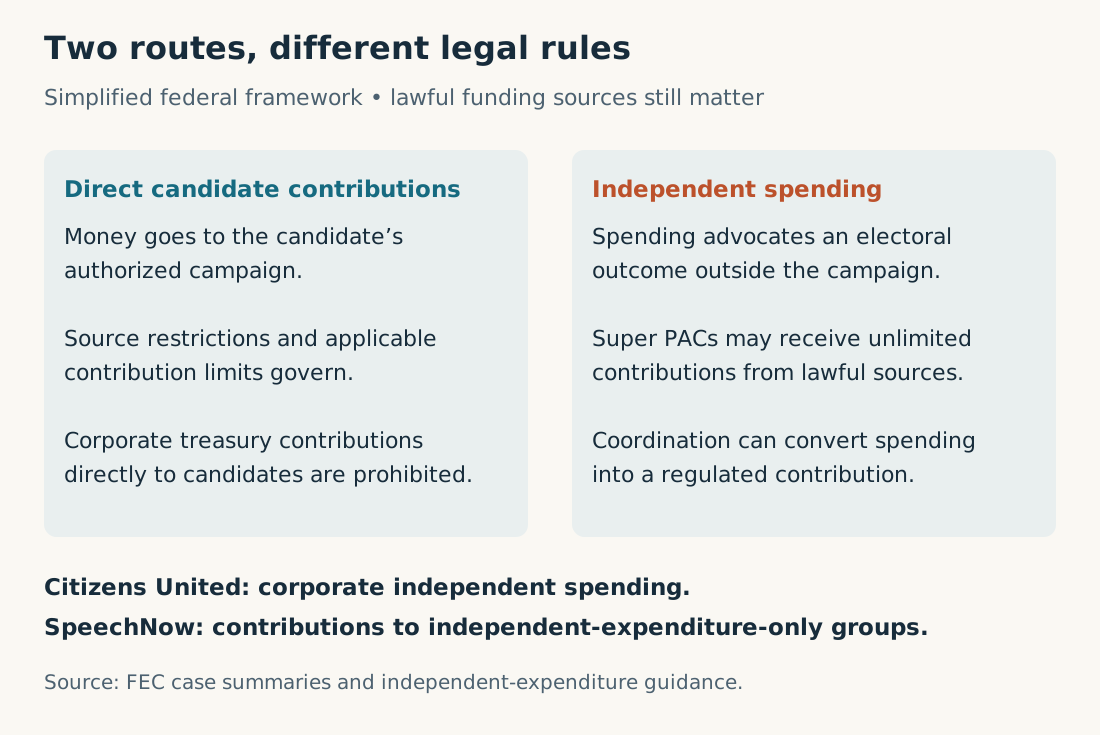
Simplified federal framework. Super PAC fundraising and corporate independent spending reflect related but distinct legal developments; other source prohibitions and reporting rules still apply.
The Court’s central premise was that independent expenditures don’t create enough corruption, or appearance of corruption, to justify the restriction. That is far too narrow. A donor doesn’t have to buy a particular vote to gain influence. Politicians know who can help them, who can fund a challenger, and who makes campaigning affordable. Access and dependence shape which proposals advance long before anyone casts a roll call vote.
Super PACs required another legal step
The D.C. Circuit’s SpeechNow.org v. FEC decision, also in 2010, struck down contribution limits for groups that make only independent expenditures. Combined with Citizens United and later rulemaking, that created the independent-expenditure-only committee we call the super PAC.34
A super PAC can take unlimited contributions from lawful sources. It can’t give to candidates or coordinate in a way that makes it a prohibited or excessive contribution. “Independent” is a legal term. It does not mean the spender has no preference or no relationship to a candidate.5 That is why enforcing the coordination rules matters. If a supposedly separate operation is an extension of a campaign, the label shouldn’t be enough.
Disclosure is necessary but not enough
Disclosure lets voters ask who paid for a message. It gives journalists and watchdogs something to investigate, and it does so without the government deciding which viewpoint is right.
But disclosure after the election is worth much less than disclosure while decisions are being made. And naming an organization often doesn’t reveal where its money came from. Reform should make election funding traceable through intermediary entities. It should also protect people who face a demonstrable risk of harassment, using thresholds and clear scope rather than a public dossier on every small donor. But again, corporations, PACs, unions, etc., are not people with thoughts, viewpoints, and moral consciences. People make choices and dollars should be traceable to people. There are certainly reasons for anonymity and some allowances should be made, but that should not allow the hiding of vast sums of money.
Mostly, though, transparency doesn’t equalize anything. Learning that a billionaire paid for an ad campaign doesn’t give an ordinary voter the means to answer it.
Influence reaches beyond election advertising
Lobbying, litigation, policy research, the revolving door, and ownership of communication platforms all shape government. Not all of it is corrupt; organized advocacy is a normal part of public life. The problem is concentrated capacity. An industry can keep teams of specialists on the payroll while the people who bear its costs have little time, money, or information to respond.
Robert Reich argues that wealth shapes the rules of the market, so that political influence and economic advantage reinforce each other.6 That is a political-economic argument, not a claim that every lobbying contact is illegal. He is largely right, and the economic policy article follows that feedback loop. Campaign finance is one part of a larger question: who gets an effective voice when the rules are written?
Alternatives and the Principles They Suggest
Make ordinary participation financially meaningful
New York City’s matching-funds program multiplies eligible small contributions from residents. Seattle’s Democracy Voucher Program gives eligible residents public money to direct to participating candidates.78
They have different rules and operate in particular local settings, so a national program can’t just copy a city’s administrative details. They do show that public financing can strengthen participation rather than just cap spending.
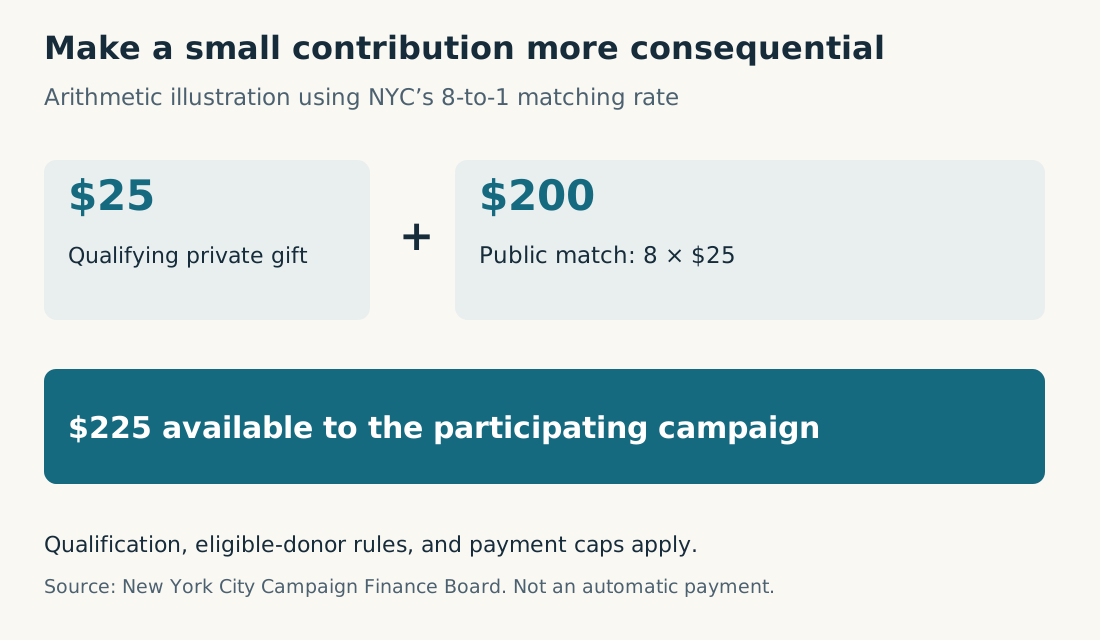
Arithmetic illustration using NYC’s matching rate. Actual eligibility, qualification requirements, matchable amounts, and payment caps apply. It is not an unconditional payment for every donation.
A candidate who can fund a competitive campaign with many modest contributions has a real alternative to courting a few wealthy backers. That changes who gets listened to.
Protect collective advocacy
People speak through organizations. Unions, civil-rights groups, churches, professional associations, and newspapers pool resources because one person can’t do everything alone. A reform that bans organized speech would damage democracy. So would one that exempts every incorporated entity without asking how its election spending is financed. But again, people matter. Organizations should be a reflection of their people and a handful of powerful donors should not be able to hide behind an “organization” that is nothing more that a name.
Consistent treatment should be a central principle, not a list of favored speakers. Rules should target defined election-finance conduct, ignore viewpoint, and protect independent journalism and ordinary issue advocacy. The boundaries are hard. An issue ad can affect an election, and a newspaper editorial can endorse a candidate. Legislators must not be allowed to turn those facts into a general power to suppress criticism.
Potential Solutions
Reverse the rule through a legitimate constitutional route
Congress can’t nullify a constitutional holding by reenacting the same restriction under a new name. A future Court could reconsider its precedent, which is one more reason who sits on the Court matters. The more durable route is a constitutional amendment authorizing reasonable regulation of election contributions and spending.9
One possibility is a narrowly drawn amendment that permits that regulation while expressly protecting political viewpoints, independent journalism, and people organizing to advocate for change. Its purpose should be preventing corruption, dependence, and domination of elections. It should not let government decide that one argument has had enough attention.
It also has to cover corporations, unions, and wealthy individuals alike. Leaving unlimited individual spending untouched while changing only corporate spending would fix one mechanism and leave the others.
Reversal doesn’t fix everything
Overruling Citizens United would not erase Buckley, SpeechNow, or every related rule. A serious proposal has to say which spending can be regulated, which contributions can be limited, and how organizations are classified. Nor would reversal cure polarization, make candidates honest, or end unequal media ownership. That is a reason to define the proposal honestly, not to give up on it.
Work on reforms that don’t require waiting
We should pursue a parallel package:
- Timely, usable disclosure of significant election spending and its sources, with protection where disclosure creates a substantiated risk. This should trace to individual citizens and once again only people, not corporations or unions, make decisions and should have free speech rights.
- Real enforcement of coordination and source restrictions.
- Voluntary public financing built around broad participation, small contributions, or voter-directed vouchers.
- Clear conflict-of-interest rules for officials, and transparency about lobbying and the move between government and regulated industries.
- An enforcement process that decides things in time, rather than letting delay work as permission.
The details must fit constitutional limits. In Arizona Free Enterprise Club v. Bennett (2011) the Court struck down a public-funding mechanism that increased a candidate’s subsidy when opponents or independent groups spent more. Matching a qualifying small donation is different. Good intentions don’t make every funding formula lawful or effective.10
Protect reform from the people administering it
The government will be enforcing rules that affect criticism of the government. That conflict can’t be avoided, only managed. I would insist on precise definitions, public decisions, enforceable deadlines, independent review, and safeguards against selective enforcement. A small civic organization should be able to understand its obligations without a permanent legal department.
Public financing needs audits and anti-fraud controls, and candidates should show real public support before receiving serious money. Then measure it: who participates, whether candidates have credible alternatives to large donors, and whether enforcement falls hardest on small groups.
The point is not to make everyone’s speech identical in reach. It is to build a democracy in which extraordinary wealth doesn’t routinely decide whose concerns can sustain a campaign. Freedom of speech protects our ability to argue about the country’s future. It shouldn’t require us to give up every practical safeguard against buying control of it.
References and Further Reading
Court decisions and official FEC explanations establish the legal distinctions. The public-financing programs are examples rather than proposed national statutory text. Recommendations in this article are policy judgments.
FEC, Buckley v. Valeo, with links to the 1976 decision and case documents. ↩︎
FEC, Citizens United v. FEC, including the independent-spending holding, retained disclosure requirements, and unchanged corporate-contribution ban. ↩︎
FEC, SpeechNow.org v. FEC, explaining the 2010 D.C. Circuit decision. ↩︎
FEC, Final Rules on Independent Expenditures and Electioneering Communications by Corporations and Labor Organizations, October 2014. ↩︎
FEC, Making Independent Expenditures, current compliance explanation. ↩︎
Robert Reich, When Billionaires Talk About Freedom, Watch Your Wallets, April 25, 2022. Commentary about concentrated economic and political power. ↩︎
New York City Campaign Finance Board, Matching Funds Program, including the eight-to-one matching framework and program qualifications. ↩︎
Seattle Ethics and Elections Commission, About the Democracy Voucher Program. Voucher distribution and eligibility depend on the election cycle. ↩︎
National Archives, The Constitution of the United States: A Transcription, Article V amendment process. ↩︎
U.S. Supreme Court, Arizona Free Enterprise Club’s Freedom Club PAC v. Bennett, June 27, 2011, majority opinion and dissent, reproduced by Cornell’s Legal Information Institute. ↩︎