A healthcare system should help people stay well, catch problems early, and manage illness before it becomes a crisis. When serious illness does come, it should provide excellent treatment without making the illness a financial catastrophe. That seems like a modest expectation for a wealthy country.
Yet Americans regularly face a different set of questions. Is the doctor in the network? Will the insurer authorize the treatment? How much of the deductible is left? Can the appointment wait until the next paycheck? Is there still a hospital close enough in an emergency?
We have extraordinary medical knowledge, skilled clinicians, and institutions capable of remarkable work. We also have a financing system that too often turns reaching them into an obstacle course. The result is too much sick care: responding after people become seriously ill, while the ordinary work of keeping them healthier is hard to get and badly funded.
We should begin with Medicare for All: universal public insurance, a comprehensive benefit, and properly funded primary care available before a problem becomes an emergency. It is a foundation, not the whole building. Prevention, continuing care, and hospital treatment still have to work together.
Where We Started
Coverage accumulated in layers
Nobody designed a coherent national system and then put it into operation. We accumulated arrangements for different groups: employment-based insurance, individual policies, public programs, and a safety net for people who didn’t fit anywhere. Medicare and Medicaid arrived in 1965 to meet different needs through different structures. Later reforms expanded coverage and added protections without replacing the patchwork.1
That is why changing jobs, crossing an eligibility threshold, or moving can change your coverage even though your medical needs haven’t changed. The system sorts people by how they qualify for payment instead of by what care they need.
Insurance is supposed to pool risk. Illness is unpredictable for an individual, but a population can finance care together. The question isn’t whether we pool risk; we already do. It is how many pools we have, who can get into them, and how much effort goes into moving money among them. Additionally, health risk is increasingly more determinable than controllable. When an insurance provider can determine based on someone’s current health, genetic makeup, neighborhood, and profession how likely they are to need expensive care, an individual can find themselves priced out of healthcare, even care to help mitigate those risks because of factors outside their control. That’s not pooled risk, that’s high-stakes gambling with the insurance industry house always in a position to win.
We built payment around episodes, not health
It is easier to bill for a procedure than for the patient who never deteriorated because a clinician noticed a problem, adjusted treatment, or coordinated follow-up. When those quieter services are poorly funded, a system rewards responding to illness more reliably than preventing it.
Healthcare includes prevention, timely diagnosis, treatment, rehabilitation, and the continuing work of living with chronic disease. Primary care is the usual source of care across all of that, as AHRQ’s discussion of primary care and patient safety emphasizes.2 “Sick care” describes an imbalance: we wait until a problem is severe, then deploy expensive resources. Emergency departments, specialists, and intensive care units do indispensable work. They shouldn’t have to make up for a primary care system people can’t reach.
We confused insurance choice with medical choice
Choosing among insurers is not choosing a physician. A person can have several plans available and find that each excludes their doctor or puts up a different barrier. An insurance card also doesn’t create a clinic. Financing and delivery are separate responsibilities, and a workable reform has to address both.
Where We Are
We spend enough to expect better
CMS reports national health spending reached $5.3 trillion in 2024, or $15,474 per person, 18.0 percent of GDP. That is national expenditure, not just insurer revenue or federal spending.3
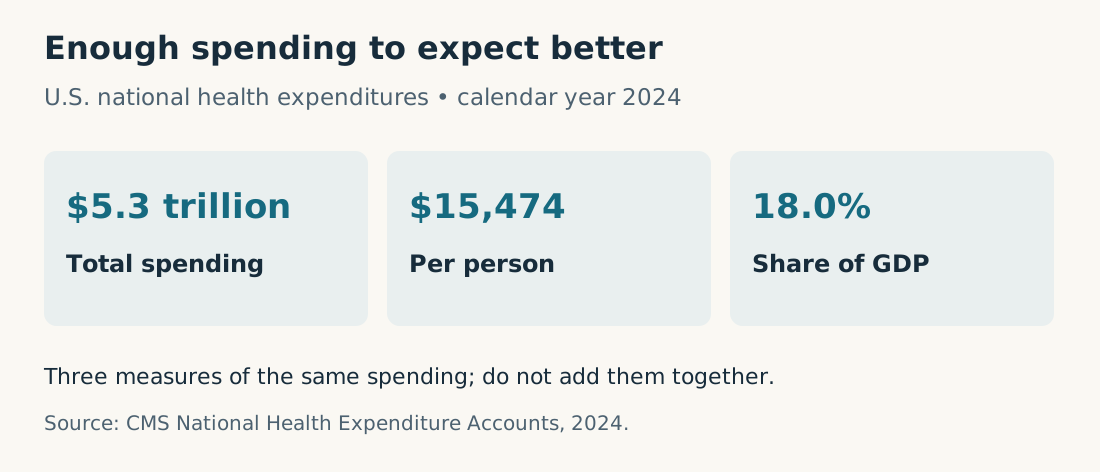
Source: CMS National Health Expenditure Accounts, calendar year 2024. These are three descriptions of the same spending, not amounts to add together.
The Commonwealth Fund’s Mirror, Mirror 2024 ranked the United States last overall among ten high-income countries, across access, care processes, administrative efficiency, equity, and outcomes. We did relatively well on care processes and poorly on most of the rest.4 A ranking isn’t a complete explanation. Country selection, measures, and weighting matter, and population health also reflects housing, inequality, violence, and diet. But spending this much while leaving this many obstacles to care should make us question the design.
To be fair, not every U.S. outcome is getting worse every year. CDC reports life expectancy rose from 78.4 years in 2023 to 79.0 in 2024.5 That is welcome. But there are many factors and it does not appear that this is a return to our historical trend of increasing life expectancy. Nor does it mean we’re doing well compared to peer countries—we’re not.6 It’s also worth noting that life expectancy is not the same as quality life years.7 Although those numbers also seem to show us well behind peer countries, with our averages showing fluctuation, but no real sustained growth in the last 20 years.
Delayed care moves the burden downstream
When an appointment, prescription, or follow-up feels unaffordable, people postpone it. The need doesn’t go away with the bill. A manageable condition worsens until urgent treatment is unavoidable.
For people with diabetes, heart failure, or chronic lung disease, reliable monitoring, medication, and continuing care can head off deterioration. AHRQ uses “potentially preventable” hospitalizations for these conditions as a way to examine access to outpatient care. The word “potentially” matters: it doesn’t mean every admission could have been avoided or that patients are to blame.8 The case is for supporting chronic care throughout an illness instead of repeatedly paying to rescue people after a crisis.
We should expect more routine chronic care once people can finally get it. The reduction we want is in avoidable complications and the emergency or intensive treatment they cause. Living well with a chronic condition takes years of continuing care; success means supporting it consistently, not pretending the condition is gone.
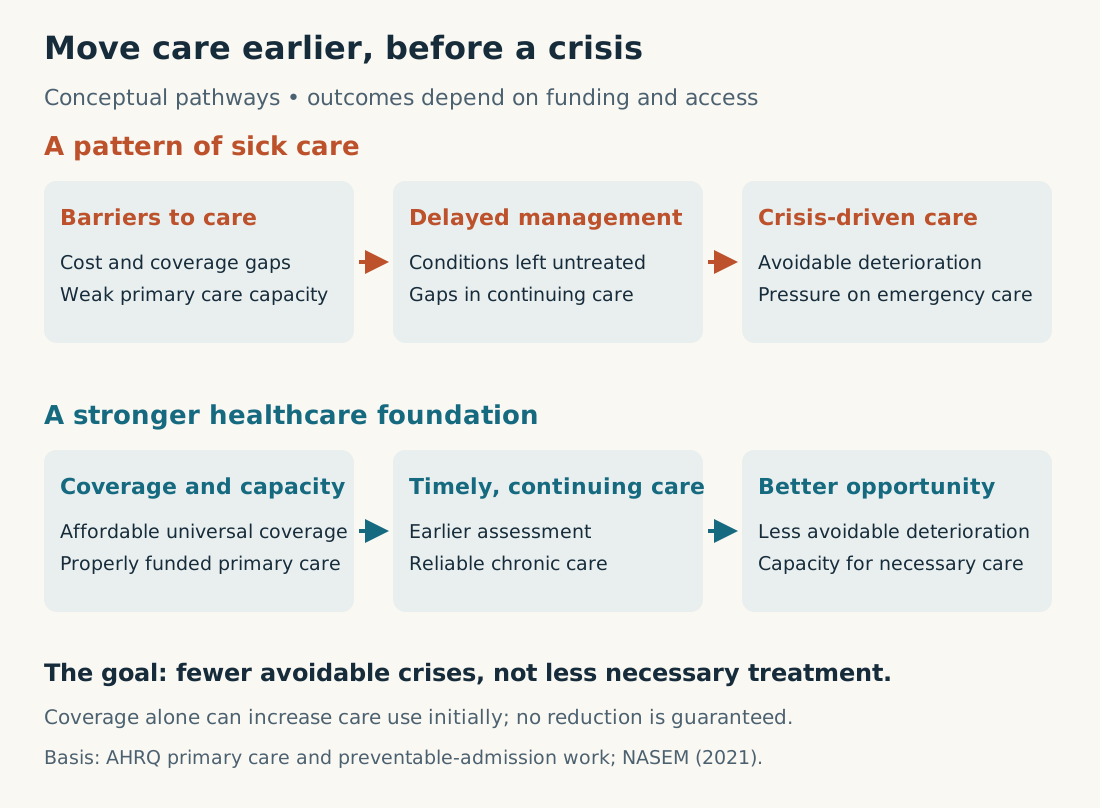
A proposed shift in the timing of care, not a forecast of how much hospital use would fall. Prevention and continuing care cannot eliminate every illness, emergency, or need for intensive treatment.
Care can disappear while coverage remains
A hospital closure is more than a line on a balance sheet. It can mean a longer drive in an emergency, a lost maternity service, or clinicians who leave. UNC’s Sheps Center tracks rural hospitals that closed completely and those that stopped inpatient services but kept something else. Those aren’t the same, but a building that still holds an outpatient clinic can still represent a major loss of local capacity.9
Physician shortages are part of it. HRSA’s 2025 projections anticipate a shortage of 70,610 full-time-equivalent primary care physicians in 2038. That is a modeled future gap, not a count of missing doctors today.10 Nationally the problem is a mix of poor distribution, an aging workforce, thin primary care capacity, and payment that doesn’t reliably support what communities need. Closing a hospital may sometimes be a reasonable reorganization. Keeping every building open forever isn’t the goal. Timely access to appropriate care is.
The financial winners are not necessarily the patients
Large healthcare companies can post big earnings while communities lose services. UnitedHealth Group reported $447.6 billion in revenue and $19.0 billion in operating earnings for 2025. That group includes both insurance and Optum, so those aren’t pure insurance profits.11 Revenue isn’t profit, and one good year doesn’t prove insurer profits rise forever. The problem is the incentive: a company can improve its results without making care more accessible or anyone healthier.
Some insurance functions are useful. Claims processing, fraud prevention, and evidence-based coverage decisions don’t become unnecessary just because the financing is public. But patients shouldn’t depend on whether denying, delaying, or complicating their treatment helps someone else’s bottom line. A 2022 HHS Inspector General study found some Medicare Advantage prior-authorization denials met Medicare coverage rules.12 This demonstrates some difference between the government plan and the commercial for-profit plan.
Existing protections have limits. The Affordable Care Act’s medical-loss-ratio rules generally require covered insurers to spend at least 80 or 85 percent of premium revenue on medical care and quality improvement, depending on the market, with the rest going to administration and profit. That constrains some spending. It doesn’t guarantee affordable prices, adequate networks, or timely appointments.13
Alternatives Other Countries Use
Start with Dr. Sally Primus’s comparative work
Dr. Sally Primus, the physician behind Slice of Life, MD, is an excellent entry point through her Healthcare Without Borders writing and country comparisons. She asks how specific arrangements work: financing, physician payment, drug prices, patient costs, and the tradeoffs a slogan hides.14 Her August 2026 article compares American primary care payment with Germany’s, and asks the useful question of whether a system that calls primary care essential actually pays for it that way. Her September article looks at public and private research contributions and Germany’s approach to drug pricing.15 I like the method because it replaces the search for a perfect foreign system with a search for better choices.
Universal healthcare is a goal, not a single design:
| Example | Broad arrangement | Lesson for a U.S. reform |
|---|---|---|
| Canada | Provincial and territorial public insurance for medically necessary hospital and physician services, with other coverage varying | Public financing need not mean government ownership of every practice; defining the benefit matters. |
| England | Tax-funded NHS services, generally free at the point of use with statutory exceptions | Access depends on budgets, staffing, and service capacity as well as the absence of an insurance bill. |
| Germany | Statutory insurance funds alongside a private-insurance system, within a regulated framework | Multiple insurers can coexist with broadly shared rules; regulation and payment design matter. |
These are, of course, simplified descriptions, not complete accounts of each country’s system.161718
No arrangement eliminates scarcity. Public systems can have waiting lists and multi-payer systems stay complicated. But Americans already wait too, for authorization, a network appointment, or enough money. Compare the barriers that actually exist, not an imperfect public system against an imaginary private one.
Potential Solutions
Medicare for All should mean an improved benefit
The Medicare for All bill Sanders, Jayapal, and Dingell introduced in 2025 is a concrete starting point: comprehensive public insurance with benefits beyond traditional Medicare and broad provider choice. It is proposed legislation, not a program available today.19 This is a positive direction. Eligibility should follow the person, not their employer, income category, or skill at navigating enrollment paperwork. Essential coverage should include primary and specialist care, hospital treatment, mental health, prescriptions, and meaningful dental, vision, and hearing benefits. Long-term services and supports need explicit treatment too. A policy shouldn’t call itself comprehensive and leave families to discover that their largest potential expense sits outside the system.
Public insurance doesn’t make every doctor a government employee. Financing and delivering care are separate decisions. The goal is that medically appropriate treatment is available through participating providers without patients negotiating several private coverage systems.
Universal coverage should make primary care ordinary
Continuous, affordable coverage lets people seek primary care without first asking whether they can afford the visit or whether a lost job has cut off their eligibility. It makes a regular care relationship and follow-up financially feasible. Universal enrollment and a comprehensive benefit go together, since being enrolled in a plan with unaffordable cost sharing can still leave care out of reach. While Medicare reimbursements are arguably too low for primary care, that is an addressable problem and the elimination of an entire layer of insurance billing infrastructure at every medical provider should provide some modest increase in actual provider profit even before reimbursement changes.
The Oregon Health Insurance Experiment found that gaining Medicaid increased use of primary and preventive care and reduced financial strain. It studied a particular expansion, not Medicare for All, but it supports the basic point that removing financial barriers changes whether people get care.20 The goal is appropriate use of primary care, not fewer encounters with medicine at any cost. Newly covered patients may need deferred exams and referrals, and seeing more of them at first means unmet needs are being addressed.
Fund primary care for the work we need it to do
Coverage can’t open an appointment slot that doesn’t exist. Primary care has to be funded for adequate staffing, time with patients, coordination with specialists, medication review, and follow-up between visits, including nurses, pharmacists, and behavioral health professionals as well as physicians. The National Academies’ 2021 report recommends paying primary care more and differently, with hybrid models that combine payment for services and prospective support for caring for a patient population.21
I would use stable, risk-adjusted funding for continuing care alongside payment for services, so a practice caring for people with greater medical and social needs has the resources to do it. Access and quality safeguards are essential so prospective payment doesn’t become one more incentive to withhold care. This is an investment in keeping people healthier, and it shouldn’t have to promise a quick financial return to some individual payer. Risk-adjustment requires thoughtful implementation to avoid the current prevalent schemes to assess patients as having fictitious ailments to increase reimbursement. That drains resources from where they’re needed as well as putting patients at risk by having false diagnoses in their records.
Give people a credible alternative to the emergency room
Emergency departments must stay open to anyone who needs them. Reducing avoidable demand means timely appointments, urgent advice, after-hours options, and continuing treatment, not discouraging frightened or seriously ill people from seeking help.
Coverage alone doesn’t guarantee fewer emergency visits. The Oregon experiment found Medicaid coverage increased emergency-department use during the study, even as other care increased. Affordable care releases unmet demand; it doesn’t automatically substitute primary care for emergency care.22 The stronger claim is that universal coverage combined with properly funded, accessible primary care lets us manage more needs earlier and reduce avoidable crises over time. Measure it through access, continuity, outcomes, and potentially preventable emergency visits and admissions.
Coverage must come with capacity
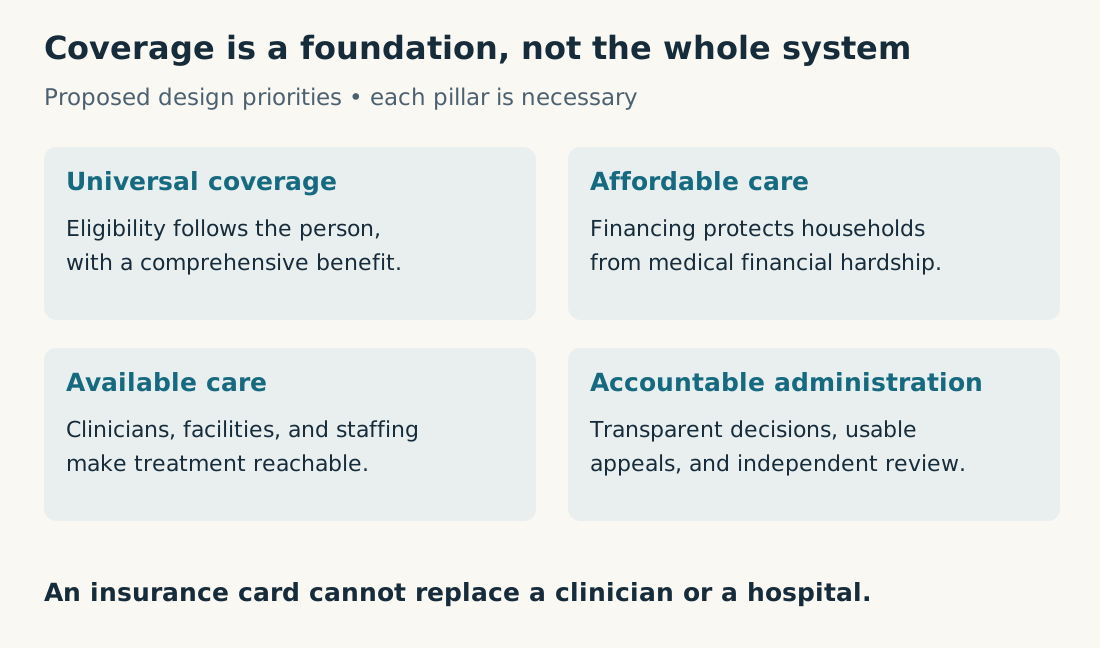
Proposed design priorities. Coverage is necessary, but a benefit cannot deliver care without clinicians, facilities, and workable administration.
Changing the payer while leaving delivery underfunded would repeat an old mistake. I would pair universal coverage with:
- A primary care payment structure that funds prevention, continuity, team-based chronic care, and time for complicated patients.
- Workforce investment, including training and incentives to practice in underserved communities. The current caps on residencies need to be raised significantly to address impending shortages. We’re already behind that curve.
- Hospital funding that pays for essential readiness and local access, not just profitable procedures.
- Negotiated drug prices and clear assessment of clinical benefit, with transparent appeals.
- Accessible scheduling, usable records, and adequate mental health and long-term care capacity.
These are design requirements, not automatic consequences of single-payer insurance. They need funding, administration, and public evaluation.
Pay for it honestly
Medicare for All moves a lot of spending onto public budgets. That alone doesn’t tell us whether the country spends more overall, because taxes can replace premiums, employer payments, and deductibles. The household question is the combined burden and the care received. A financing plan should show its effect across income levels and family circumstances, including employers’ contributions and the chance that compensation adjusts.
CBO’s 2020 analysis of illustrative single-payer designs found national spending could fall or rise depending on payment rates, cost sharing, and benefits, and warned that demand could outrun supply. Those weren’t a score of the 2025 bill, and nobody should reuse the dollar figures as guaranteed savings.23 Administrative simplification and bargaining power are real opportunities. Newly affordable treatment raises demand. Cutting provider payments too fast can undermine the clinics and hospitals the reform is meant to protect. All three belong in the same discussion. Not every preventive service reduces lifetime spending either, and people who live longer still need care, so the financial case should identify avoidable costs realistically.
Plan the transition around patients
A workable transition preserves treatment relationships, keeps hospitals financially stable, and moves enrollment and payment in tested stages. People who work in insurance administration deserve retraining and income support; their livelihoods are not an accounting adjustment. We will need published milestones, independent financial review, and measures of real access: whether people have a regular primary care team, appointment waits, travel distances, continuity, potentially avoidable emergency visits and hospitalizations, financial hardship, and disparities. Public administration should face the same transparency we demand of private administration.
None of this happens easily. A financing structure that serves patients will be hard to establish if incumbents can use concentrated wealth to preserve barriers and favorable payment rules, which is the argument in money in politics and economic policy. It also depends on a legislature that actually answers to voters, which is what the representation article is about.
The case for Medicare for All isn’t that government can do no wrong. It is that care should be organized around a public obligation, not around your bargaining position when you’re sick. The first question should be how to help people stay healthier and live well with chronic illness. When serious treatment is needed, it should be there. A system that repeatedly pays for rescue while neglecting the care that could prevent some crises has its priorities backward. We don’t need a perfect system. We need to stop treating the failures in other systems as a reason to accept failures in our own, and start funding healthcare as deliberately as we fund sick care.
References and Further Reading
CMS, History, including the creation of Medicare and Medicaid in 1965. ↩︎
AHRQ/PSNet, Primary Care and Patient Safety: Opportunities at the Interface, on a usual source of care, prevention, and chronic disease management. ↩︎
CMS, NHE Fact Sheet, calendar year 2024 expenditures. ↩︎
Commonwealth Fund, Mirror, Mirror 2024: A Portrait of the Failing U.S. Health System, September 19, 2024. A comparison of ten selected countries, not a worldwide ranking. ↩︎
CDC/NCHS, Mortality in the United States, 2024, Data Brief 548, January 2026. ↩︎
By Shameek Rakshit, Lynne Cotter, and Matt McGough, Peterson-KFF HealthSystemTracker, How does U.S. life expectancy compare to other countries? ↩︎
World Health Organization, The Global Health Observatory, Healthy Life Expectancy (HALE) ↩︎
Audrey J. Weiss and H. Joanna Jiang, AHRQ, Geographic Variation in Potentially Preventable Inpatient Stays for Chronic Health Conditions, 2016, Statistical Brief 264, September 2020. Historical analysis using prevention quality indicators; not proof that any individual hospitalization was avoidable. ↩︎
UNC Sheps Center, Rural Hospital Closures, continuously maintained tracker and definitions. Totals can change; complete closures and converted facilities are distinguished. ↩︎
HRSA, State of the Primary Care Workforce, 2025. Projections depend on modeling assumptions. ↩︎
UnitedHealth Group, 2025 Results and 2026 Outlook, January 27, 2026. Company-wide results, including Optum; operating earnings differ from net income. ↩︎
HHS Office of Inspector General, Some Medicare Advantage Organization Denials of Prior Authorization Requests Raise Concerns About Beneficiary Access to Medically Necessary Care, April 2022. ↩︎
CMS, Medical Loss Ratio. ↩︎
Sally Primus, Slice of Life, MD, Healthcare Without Borders: If Primary Care Is So Important, Why Do We Pay It So Much Less?, August 8, 2026; publication homepage. ↩︎
Sally Primus, Healthcare Without Borders: Who Is Really Paying for New Medication Development, Why Americans Pay So Much for Pharmaceuticals, and What Germany Does Differently, September 5, 2026. ↩︎
Health Canada, About Canada’s Health Care System. ↩︎
UK Department of Health and Social Care, Handbook to the NHS Constitution for England. ↩︎
German Federal Ministry of Health, Statutory Health Insurance. ↩︎
Senator Bernie Sanders’s office, Sanders, Jayapal, Dingell, Hundreds of Health Care Workers Introduce Medicare for All, April 29, 2025. Sponsor’s explanation of proposed legislation; projected benefits require independent assessment. ↩︎
Oregon Health Insurance Experiment researchers, Evidence from the First Year, NBER, on utilization, financial hardship, and self-reported health following coverage expansion. ↩︎
National Academies of Sciences, Engineering, and Medicine, Implementing High-Quality Primary Care: Rebuilding the Foundation of Health Care, 2021, implementation recommendations on paying primary care more and differently and supporting care teams. ↩︎
Sarah Taubman and colleagues, Medicaid Increases Emergency-Department Use: Evidence from Oregon’s Health Insurance Experiment, Science, 2014. A randomized coverage expansion; its findings do not estimate the effects of a national single-payer system paired with a primary care investment program. ↩︎
CBO, How CBO Analyzes Proposals for a Single-Payer Health Care System, December 10, 2020, with links to design analysis and working papers. Illustrative options, not a score of today’s legislation. ↩︎