Markets do useful things. They let people try ideas, discover demand, build businesses, and challenge the established way of doing something. Competition can reward better products and make failure less permanent. None of that requires believing that whatever makes the most money must be good for society.
The “greed is good” version of capitalism turns morality on its head. It says extracting more value for an owner is sufficient justification for a business decision, even when the costs land on workers, customers, communities, or the environment. Greed is instead a deadly sin, but you needn’t delve into Judeo-Christian ethics to discover how harmful it is. Competition drives people to do better for themselves and for society, but unregulated capitalism actually distorts competition and rewards rent-seeking behavior.
I favor a market economy with strong public guardrails: real competition, worker bargaining power, consumer protection, and limits on turning wealth into political control. Profit can be a reward for serving people. It shouldn’t be an excuse for exploiting their lack of alternatives.
And let’s be honest with our terms. A competitive, capitalist economy strongly regulated is not socialism and it’s not communism. Protecting the vulnerable and restricting people’s basest behaviors does not change the basic economic system.
Where We Started
Markets have always needed a rulebook
Property rights, contracts, corporate organization, bankruptcy, patents, and liability are all legal arrangements, and a market operates inside them. Declining to change a rule is still a decision about whose interests the rule serves.
Robert Reich makes this point forcefully: the so-called free market depends on laws and rules, and powerful actors can influence those rules to reinforce their position.1 That undercuts the simple choice between “the market” and “government interference.” There is already government in the market. The real questions are whether its rules are justified, whose opportunities they protect, and whether the public can change them. None of this means success is politically manufactured. People innovate and take risks. They do it on a playing field somebody has defined.
Competition needed protection from competitors
Businesses don’t always prefer competitive markets. A firm may compete hard until it has a protected position, then work to make competition harder. The Sherman Act of 1890 and the later Clayton and Federal Trade Commission Acts were an answer: constrain restraints of trade, anticompetitive conduct, and mergers that threaten competition.2
Scale can bring real benefits: lower unit costs, better logistics, serious research investment, or a service that works because many people use it. The question is whether those benefits require letting the same firm block entry, control dependent businesses, or dictate terms to people who can’t realistically leave.
A slogan became a permission structure
Greed isn’t new, and earlier capitalism was no golden age of fairness. What changed is the normalization of a narrower standard, where shareholder returns become the dominant measure and other obligations are obstacles to get around. Reich emphasizes that we need both laws and norms. If restraint depends entirely on executives’ goodwill, a company that ignores it gains an advantage over one that behaves responsibly.3
That is why asking companies to be nicer doesn’t work. A durable system has to make harmful behavior costly and beneficial behavior viable.
Where We Are
Success and extraction can look the same on a balance sheet
A company can raise earnings by providing better products and services than others serving a market. It can also raise earnings by making cancellation harder, restricting repair, raising fees on dependent sellers, suppressing competition, or moving risk onto other people. Every one of those improves a financial measure of a specific entity by harming others rather than making a fair trade with others.
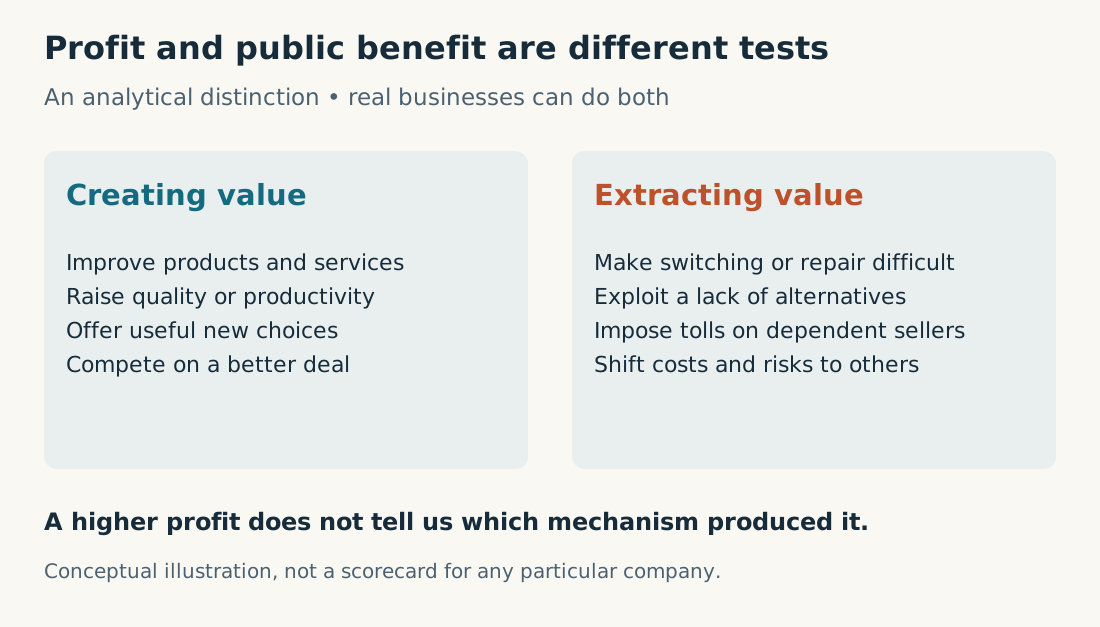
An analytical distinction, not a classification of every profitable business. Real firms can combine productive activity with harmful practices.
Economists call returns sustained by a protected advantage, rather than an open contest, rents. Some temporary advantages, such as carefully designed intellectual-property rights, encourage investment. Others just preserve the power to collect a toll. The policy job is telling them apart. Eliminating every reward discourages useful effort; treating every reward as proof of useful effort protects exploitation.
Monopoly is not the only concentration problem
A monopolist has power as a seller. A dominant buyer has power in the other direction, over suppliers, contractors, and workers with few alternative customers or employers. The Treasury Department’s 2022 report on labor-market competition looked at how concentration and anticompetitive practices weaken workers’ bargaining power.4 Competition policy is about wages and mobility, not just prices at the checkout. If you have few realistic employers, “just get another job” offers little protection. If you must reach customers through one platform, being formally independent doesn’t mean negotiating as an equal.
This doesn’t mean a large organization, a high price, or even a monopoly position is automatically unlawful under U.S. antitrust law. The FTC distinguishes monopoly power gained through superior products or business acumen from power obtained or kept through exclusionary conduct.5 Harmful concentrations need a new policy response when current law allows antisocial behavior.
Cory Doctorow describes the loss of exit
Cory Doctorow’s account of enshittification describes a platform pattern: attract users, build dependence, reshape the deal for business customers, then extract more of the value for the platform.6 The force of the idea is the analysis of power, not just the word. A service can get worse and stay profitable if customers can’t leave without losing contacts, audiences, purchased media, or access to a market. I provide a description of a concrete case in Gmail Enshittification, where Google is removing features that I, and other people with their own domains, have long depended on. Google’s near monopoly position and customer lock-in in the space makes it easy for them to remove services while raising costs without significant fear of lost business.
Doctorow’s work on interoperability points toward a remedy: let people change services without abandoning everything built on the old one.7 That principle extends well beyond social media. Repairable equipment, transferable records, transparent contracts, and the ability to use another supplier all strengthen a customer’s real options. Email interoperability allows people to leave Gmail when the service gets worse. The fact they are now limiting interoperability with other domain providers is arguably just rent-seeking behavior.
Economic power can buy protection for economic power
Money in politics explains how large financial resources influence public agendas without anyone buying a vote. Here the process feeds itself. A protected market position generates returns. Those returns finance lobbying, election spending, and litigation to preserve favorable rules. The rules then sustain the position.
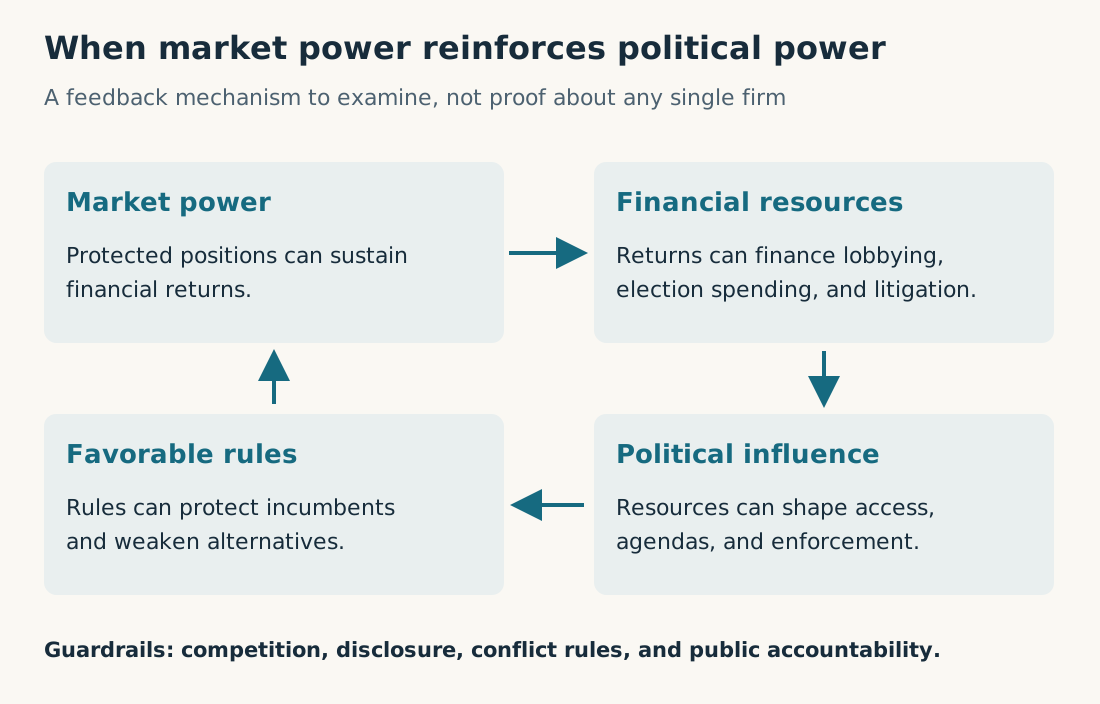
A mechanism to examine, not evidence that every company follows it or that any particular contribution caused a policy decision.
Elizabeth Warren’s speeches on corporate monopolies tie competition directly to democratic power: concentrated businesses can dominate markets and weaken the public’s ability to govern them.8 I share that concern. Oligarchy isn’t simply a society that contains rich people. It is one where a small, wealthy group can disproportionately decide the rules everyone else lives under. The same dynamic of insiders writing their own rules shows up in how we draw districts and run elections.
Alternatives and the Principles They Suggest
Preserve markets while changing the terms
We don’t have to choose between leaving every decision to concentrated private power and having the state direct every transaction. Public rules can protect the competitive process while businesses decide what to offer and consumers decide what to buy. A safety standard applies to every supplier. A fair labor rule keeps responsible employers from being undercut by abusive ones. An interoperability requirement lets a newcomer offer a service without rebuilding a whole network.
These interventions need evidence and proportion. A rule with enormous fixed costs can protect the biggest firms by making entry harder. A consumer protection nobody can enforce accomplishes little. The goal isn’t regulation measured by pages. It is a market where competing and leaving remain realistic, and where third parties don’t bear costs nobody accounts for.
Recognize where competition is insufficient
Some services don’t fit a consumer-choice model. Nobody comparison shops during a medical emergency, and a community gains little from duplicating every utility network just to have competing providers. There, public provision, regulated rates, or universal-service obligations may be the better tool. The healthcare article makes this concrete: universal public insurance can coexist with many kinds of providers, and the fact that a market can organize one part of a service doesn’t settle how to finance the whole public obligation. Similarly, utility competition among providers in the gas and electric industries along with regulated monopolies for distribution can be beneficial. Having multiple duplicative, expensive distribution networks provides little benefit to anyone, but increases costs. Careful thought to first-principles is required though. For example a government enforced monopoly for “cable” providers for a geographic area can prevent expensive duplication, but if the monopolist is not required to provide access to that infrastructure to other providers the monopolist will almost certainly extract fees much higher than they would if competition was enforced.
Potential Solutions
Make competition policy about practical power
I would strengthen antitrust enforcement against exclusionary behavior and look hard at mergers for their effects on customers, workers, suppliers, and future entrants. The Clayton Act’s merger standard is preventive; it reaches deals that may substantially lessen competition or tend to create monopoly. Waiting until every consequence can be measured can mean waiting until the rival is gone.9
Enforcement still needs a theory of harm, evidence, and due process. Size alone is not an analysis, and a claim of efficiency shouldn’t excuse a structure that gives one company control of a whole market. Remedies should match the problem. Sometimes banning a practice is enough. Sometimes a dominant firm keeps evading behavioral conditions and structural separation makes more sense. Breaking up a business should be a reasoned remedy for concentration or conflicts of interest, not a punishment for success.
Restore the ability to leave
We must have usable data portability, appropriate interoperability, and a practical right to repair. An export button that produces unusable files is not portability. An appliance serviceable only through the manufacturer’s chosen channel is worth less than the sales contract suggests. Interoperability has to protect security and privacy too; giving buyers a choice shouldn’t mean handing every other buyer’s information to unaccountable third parties.7
The test is simple: can a person or business change providers without paying an unreasonable penalty in lost relationships, records, purchases, or working equipment?
Give workers and smaller businesses bargaining power
Competition among employers matters, but it isn’t the only safeguard. We need to defend collective bargaining, enforce wage and safety rules, and address practices that needlessly restrict job mobility. Smaller suppliers need fair access to customers as well. A platform that runs a marketplace while competing with the businesses on it almost certainly has a conflict that is harmful. Transparency, nondiscrimination, or separation may be justified depending on the market.8 Nobody is owed a profit. But dependence shouldn’t become a license to impose terms the other side can’t refuse.
Stop treating shifted costs as efficiency
An operation can look efficient because it sends pollution downstream, leaves workers uninsured, or hands long-term risk to the public. That is cost shifting, however good the accounts look. We must strengthen liability, environmental standards, consumer protection, and financial safeguards so businesses carry a fairer share of the risks they create. Walmart should not be able to escape the costs of providing medical coverage to their employees simply because they’re the only real employer in an area.
Taxes should support the public foundations of enterprise, meaning education, infrastructure, courts, research, and basic security, among others without letting the most powerful actors escape obligations that ordinary households and smaller firms carry. There are tradeoffs to every method of funding services, but fairness, transparency and competition should be forefront. Opportunities for rent-seeking should be minimized. Healthcare is an example where eliminating most of the health insurance industry can likely improve the system for all the participants while eliminating or vastly reducing the costs now extracted as insurance profits.
Break the political feedback loop
Competition rules stay vulnerable if the people they bind can dominate the process that writes and enforces them. I would pair economic reform with campaign-finance reform, lobbying transparency, conflict rules, and enough resources for independent enforcement, and with a Supreme Court whose members are held to enforceable ethical standards. Regulators should be watched for capture as well as incompetence. A company shouldn’t get favorable treatment because it funds the right allies, or face retaliation because its owners back the other side. A government strong enough to restrain concentrated business power is strong enough to misuse it.
Measure whether people’s options improve
Stock prices and aggregate growth are useful, but they don’t show who gained bargaining power or who lost access to an essential service. We should track entry by new competitors, switching costs, real wages and mobility, service quality, complaints, and the distribution of gains. Where a market needs special oversight, reliability and universal access belong in the assessment.
Reich, Warren, and Doctorow come at these issues from different directions. Together they make a useful point: bad outcomes often follow from rules that let concentrated power escape meaningful constraint. Competition is valuable when it gives people choices and rewards useful work. It is much less valuable as a slogan defending an incumbent against the rules needed to keep competition alive. Greed can explain behavior. It shouldn’t be the principle by which we decide whether that behavior deserves society’s protection.
Lastly, let us not confuse economic well-being with well-being in general. Money can measurable improve one’s life. But there is abundant evidence that it does not produce happiness or a long, healthy life by itself. Moreover, a society with deep economic inequality suffers even more in terms of real health and happiness. We must begin to focus more on the real people within our political systems.
References and Further Reading
The named authors’ arguments are commentary and advocacy, identified as such. Official antitrust explanations distinguish existing law from the policy changes recommended here.
Robert Reich, When Billionaires Talk About Freedom, Watch Your Wallets, April 25, 2022, on market rules and concentrated political power. ↩︎
FTC, The Antitrust Laws, explaining the Sherman, Clayton, and FTC Acts. ↩︎
Robert Reich, The Monsters of American Capitalism, December 23, 2022, on greed, accountability, laws, and norms. ↩︎
U.S. Treasury, Report on Labor-Market Competition and Workers’ Bargaining Power, March 7, 2022, linking to the underlying report. Historical analysis, not a measurement of every labor market today. ↩︎
FTC, Monopolization Defined, distinguishing success through superior products from unlawful exclusionary conduct. ↩︎
Cory Doctorow, TikTok’s Enshittification, January 21, 2023. The author’s account of platform value allocation and lock-in. ↩︎
Cory Doctorow, The Disenshittified Internet Starts with Loyal User Agents, May 7, 2024, on interoperability and user control. ↩︎ ↩︎
Senator Elizabeth Warren, Speech on Protecting the Economy and Democracy from Corporate Monopolies, 2023. A policy argument for stronger competition enforcement and checks on concentrated power. ↩︎ ↩︎
FTC, Mergers, explaining the preventive standard in Section 7 of the Clayton Act. ↩︎